
EL (Electroluminescence) Testing for solar PV
JSR Renewable Consultants works exclusively in solar PV modules. This single-sector focus means our team carries a depth of expertise that generalist consultancies cannot match. Each service is powered by our proprietary in-house software suite — ensuring every finding is digital, traceable and delivered faster.
EL (Electroluminescence) Testing
IPPs Insurance Claims Warranty Claims
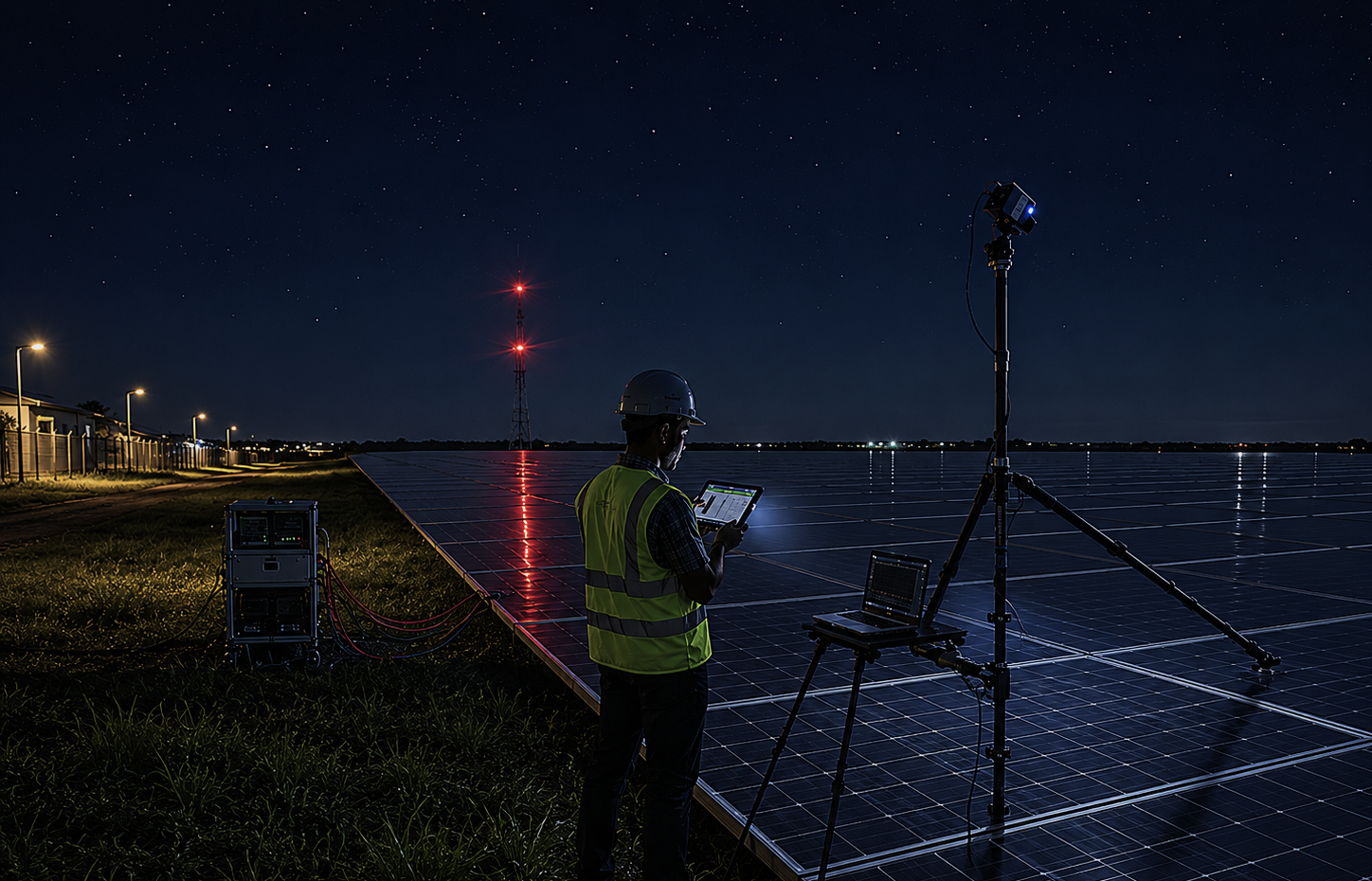
Micro-cracks, inactive cell zones and solder joint failures are invisible to even the most thorough visual inspection — EL testing reveals them. By forward-biasing each module and capturing the near-infrared light emitted by its cells, our silicon CCD camera produces an image that shows the internal condition of every cell, on-structure, without removing the module from its mounting. What separates JSR`s EL service from a basic photo exercise is what happens to that image next: our proprietary AI EL Analysis Software, developed in-house since 2023, processes each image to automatically detect, classify and severity-score every defect — giving your engineers a structured, machine-verified finding rather than a raw photograph requiring manual interpretation. Every analysed image is stored in WorkSpace against the module`s serial number and site location.
Post-shipment (transport damage) · Post-installation (construction wear) · Before end of manufacturing warranty · Annually for tracker-mounted modules · Every 3 years for fixed-tilt O&M · Insurance claims at any stage
Frequently asked questions
Still have a question?
View all FAQs →What is EL (electroluminescence) testing?
Electroluminescence (EL) testing works like an X-ray for solar panels—passing a controlled forward electrical current through a photovoltaic module so the silicon cells emit a faint near-infrared glow. Captured using specialized high-resolution infrared cameras in low-light conditions, healthy silicon shines brightly and uniformly, while damaged or disconnected areas show up as dark lines, patches, or patterns. This allows JSR Renewable Consultants engineers to pinpoint invisible internal flaws—including cell micro-cracks, inactive cell zones, broken grid fingers, cold solder joints and Potential Induced Degradation (PID)—that cannot be detected by the naked eye or standard thermal cameras.
Can EL testing be done on modules already installed?
Yes—our field engineers perform on-site EL testing directly on installed mounting structures without unbolting or removing a single solar module from your racking. By connecting portable DC power supplies to individual modules or full strings after sunset (or inside portable dark-room setups), we capture crisp, IEC TS 60904-13-compliant EL images right in the field. Performing tests on-structure eliminates the risk of accidental mechanical handling damage during unmounting and ensures zero daytime generation loss for your utility-scale solar plant.
How does JSR analyse EL images?
Every captured EL image is processed through our proprietary, in-house AI EL Analysis Software, which automatically detects, classifies and assigns a severity score to every internal defect across the module. Rather than relying on slow, inconsistent manual review, our AI distinguishes harmless hairline fractures from critical cross-cracks or electrically isolated cell regions, giving you objective pass/fail grading at scale. Each analyzed image is then stored on our JSR WorkSpace platform alongside its exact module serial number, string ID and site location so your team has complete, permanent traceability.
What specific defects can EL testing detect that visual or thermal checks miss?
While visual inspections only spot surface damage and thermal imaging only detects defects that have already started overheating, EL testing reveals internal cell damage long before major power loss or hotspots develop. It accurately uncovers hairline and dendritic micro-cracks caused by rough transport or installation foot traffic, broken busbar solder joints, shunted cells, moisture-induced corrosion patterns, early Potential Induced Degradation (PID) and bypassed sub-strings—catching hidden failures early while they are still covered under transit insurance or manufacturer warranties.
At which stages of a solar project should EL testing be conducted?
EL testing delivers critical protection at four key project milestones: during Pre-Dispatch Inspection (PDI) at the factory to verify manufacturing quality; upon material arrival at site (receiving inspection) to catch rough-handling transport cracks before signing delivery receipts; immediately after mechanical installation to ensure installation crews did not step on or bend panels during mounting; and during annual O&M audits or warranty disputes to diagnose sudden string underperformance and prove root-cause liability.
Not sure which service you need?
Let's figure it out together
Every engagement starts with a conversation. No obligation, complete confidentiality.