
I-V Curve Tracing & Measurement for solar PV
JSR Renewable Consultants works exclusively in solar PV modules. This single-sector focus means our team carries a depth of expertise that generalist consultancies cannot match. Each service is powered by our proprietary in-house software suite — ensuring every finding is digital, traceable and delivered faster.
I-V Curve Tracing & Measurement
IPPs O&M Teams Lenders Insurance Claims
A module that clears the production line is not automatically a module that deserves to be shipped. Every manufacturing lot carries the risk of cosmetic defects, underperforming cells, incorrect labelling, or improper packing — risks that our PDI service is designed to intercept before the consignment leaves the factory gate. JSRs Pre-Dispatch Inspection places an independent, qualified engineer at the facility to conduct a structured sampling inspection against AQL criteria — covering visual condition, flash testing, EL imaging, packing integrity and factory acceptance tests as defined in the QAP. Every finding is logged digitally through our JSR PDI App, with reports published to WorkSpace so your procurement team can track status and access evidence in real time, without scattered email attachments or WhatsApp communications.
Many owners schedule regular surveys · After severe weather · After an unexplained drop in performance · The right interval depends on the type of asset, its age and how critical it is and we can suggest one for your site
Frequently asked questions
Still have a question?
View all FAQs →What is I-V curve tracing?
I-V (Current-Voltage) curve tracing is a diagnostic electrical test that measures the real-world power performance of a solar module or an entire string right in the field. By sweeping the electrical load from short-circuit current ($I_{sc}$) to open-circuit voltage ($V_{oc}$), our engineers plot the complete electrical signature of your solar panels and compare it against the manufacturer’s original datasheet. Any distortion in the curve's shape clearly reveals hidden problems that basic voltage or current meters miss—including degraded modules, series resistance from loose or corroded connectors, module mismatch losses, shading effects and failed bypass diodes.
Do modules need to be removed for I-V curve testing?
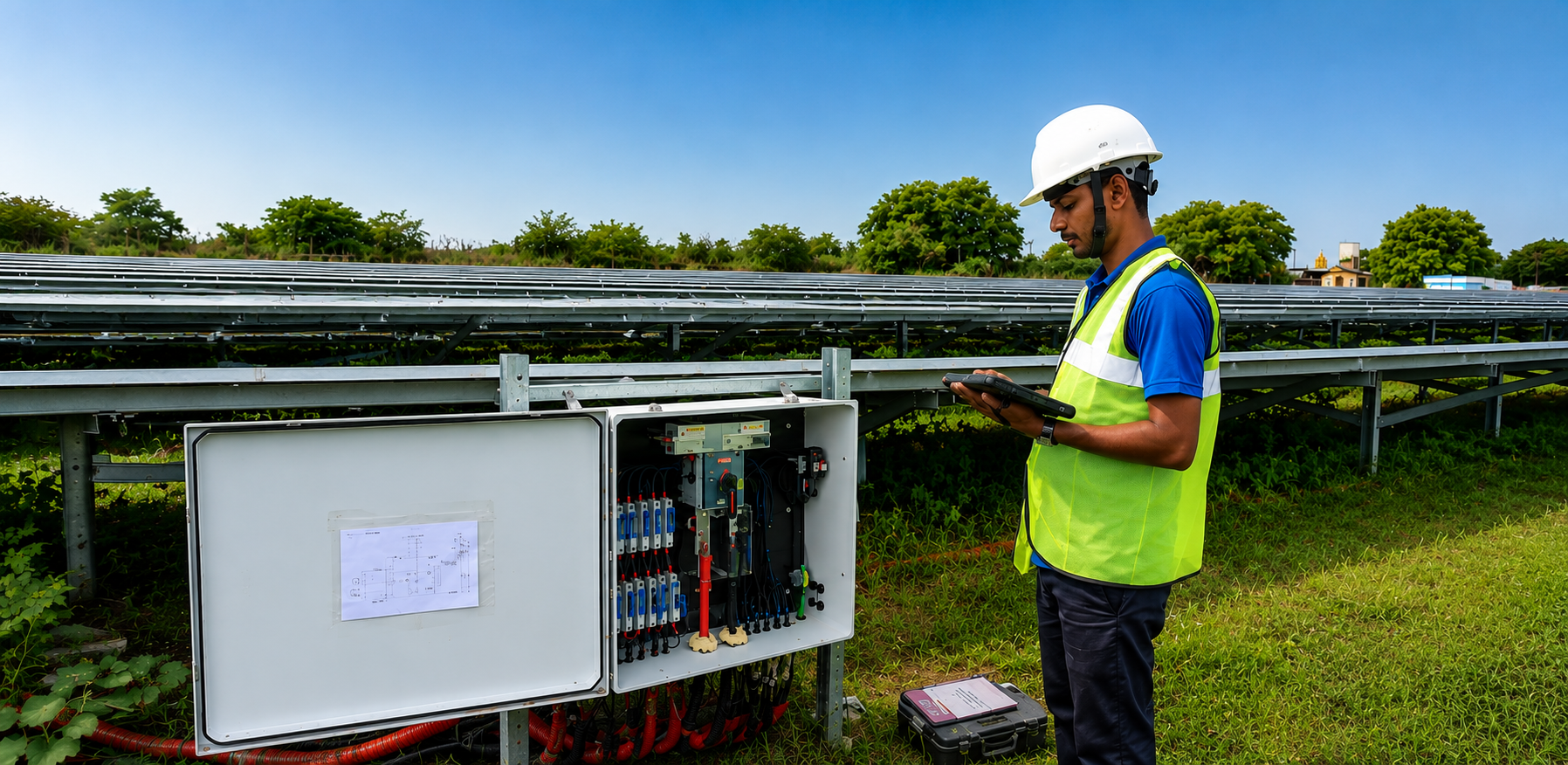
No—all I-V curve testing is performed directly on your installed mounting structures at either the string level or the individual module level, meaning there is zero unmounting, no mechanical handling risk and minimal plant downtime. Our field engineers connect portable, high-precision I-V curve tracers directly to string leads or combiner boxes on-site, allowing us to test dozens of strings rapidly while keeping the rest of your utility-scale solar plant running normally.
Can I-V testing be combined with other tests?
Yes—combining I-V curve tracing with Electroluminescence (EL) imaging and aerial drone Drone thermography gives you the most complete, 360-degree view of your solar plant's health. While drone thermography quickly scans large areas to locate hot spots and EL imaging captures X-ray-like views of invisible cell micro-cracks, I-V curve tracing measures the exact electrical power loss caused by those defects. Together, these three tests pinpoint both where a problem is and how much energy it is costing you, creating rock-solid technical evidence for warranty claims and O&M repairs.
How are outdoor I-V measurements compared accurately to factory ratings?
Because outdoor sunlight and panel temperatures constantly change throughout the day, raw field readings cannot be compared directly to a manufacturer's lab rating. During every test, JSR Renewable Consultants measures real-time plane-of-array solar irradiance and back-of-module cell temperature alongside the electrical curve, then applies international IEC 60891 translation standards. This mathematically converts your field results to Standard Test Conditions (STC — 1,000 W/m² irradiance and 25°C cell temperature), giving you an exact comparison against the module’s nameplate wattage.
When is the best time to perform I-V curve tracing on a solar project?
I-V curve tracing adds critical value at three main stages of a utility-scale solar project: during commissioning, during annual O&M health checks and during asset acquisitions or warranty audits. Running I-V tests right at project handover establishes an official baseline performance record for every string before the contractor leaves. Repeating the test annually or whenever SCADA monitoring flags an underperforming inverter block lets you track exact year-over-year degradation rates and catch sudden faults early.
How does JSR deliver the I-V curve tracing data and reports?
Every traced curve, STC-converted parameter and pass/fail diagnostic note is logged digitally and published directly to the JSR WorkSpace online platform. Your engineering and O&M teams can log in anytime to compare string-by-string performance, view visual curve overlays, spot outlier strings immediately and download standardized PDF and CSV reports for lenders, owners, or warranty submissions.
Not sure which service you need?
Let's figure it out together
Every engagement starts with a conversation. No obligation, complete confidentiality.